Channels Page
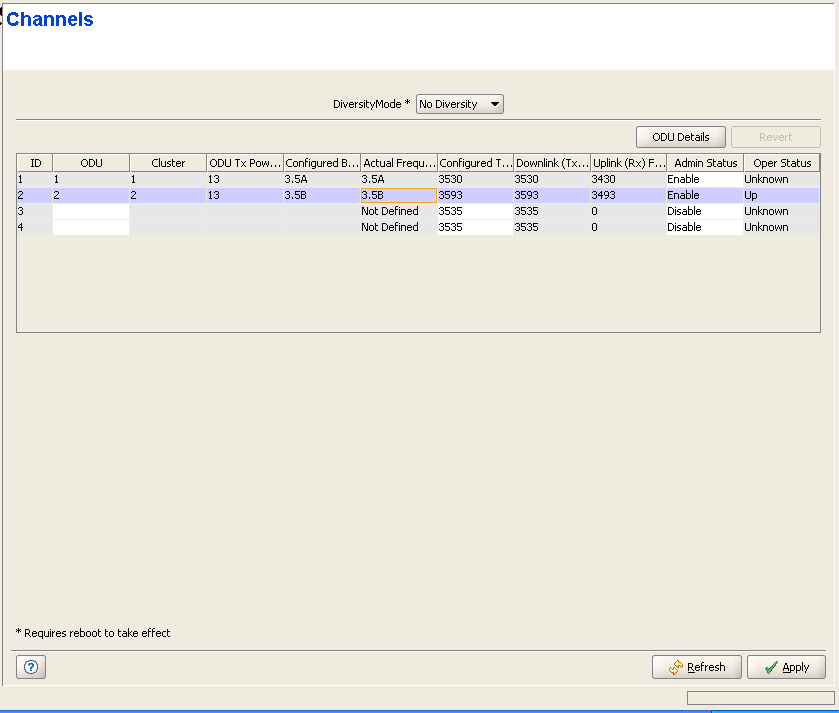
The Channels page enables viewing and configuring the Diversity Mode of the AU/Micro Base Station and the parameters of the AU/Micro Base Station Channels.
|
Diversity Mode: The Diversity Mode of the AU. The available options are:
• No Diversity
• Second Order Diversity
• Rx Diversity
In No Diversity mode each channel serves a different sector, using a different frequency. Second Order Diversity, intended primarily for Non Line Of Sight (NLOS) deployments, use time and space diversity scheme in the downlink and ODU selection based on SNR in the uplink. Rx Diversity may provide better performance in certain deployments with both NLOS and LOS, and it uses only SNR-based selection in the uplink. In Rx Diversity the ODU connected to Channel 2 operates in receive only mode (the transmitter is switched off).

|
NOTE |
A change in the Diversity Mode parameter takes effect immediately and automatically resets the AU/Micro Base Station and disables its channels. |
The Channels table has four entries for Channels 1 to 4. In the current version only Channels 1 and 2 are applicable. The Channels table include the following parameters for each Channel:
Parameter |
Description |
ODU |
An ODU ID (1-24 for a Modular Base station, 1-4 for a Micro Base Station) of an already defined ODU. |
Cluster |
A read-only display of the Associated Radio Cluster configured in the associated ODU. |
ODU Tx Power |
A read-only display of the Tx Power configured in the associated ODU |
Configured Frequency Band |
A read-only display of the Configured Frequency Band in the Associated ODU. |
Actual Frequency Band |
A read-only display of the actual Frquency Band of the ODU. |
Configured Tx Frequency |
The Tx frequency in MHz, which must be in accordance with the Bandwidth configured for the AU/Micro Base Station and the rules defined in the Frequency Bands File (see "Frequency Bands File Page" ) for the frequency band selected as the Configured Band of the associated ODU. In addition, the following rules must be followed if the Diversity Mode is No Diversity: • After configuring the Tx Frequencies f1 for one of the Channels, the Tx Frequencies for other Channel of the same AU/Micro Base Station should be configured using increments of +/- 0.875 MHz from the defined frequency: f1 +/-(N*0.875). • The Tx Frequencies of all Channels of the same AU/Micro Base Station should belong to the same Frequency Bands Group (see "Frequency Bands File Page" ). f the Diversity Mode is set to Second Order Diversity or Rx Diversity, the Tx Frequency of Channel 2 is not configurable: when the Admin Status of Channel 1 is enabled, The Configured Tx Frequency of Channel 2 is set automatically to the same value configured for Channel 1. |
Downlink (Tx) Frequency (MHz) |
A read-only display of the actual Downlink Frequency in MHz. |
Uplink (Rx) Frequency (MHz) |
A read-only display of the Uplink Frequency in MHz, computed from the Tx Frequency according to the Duplex Separation of the applicable Frequency Band. |
Admin Status |
The administrative status of the Channel. Note that the Admin Status must be disabled to enable changes in the Configured Frequency Band of an associated ODU. If the Configured Frequency Band differs from the actual band supported by the ODU, a mismatch trap will be sent by the AU/Micro Base Station upon trying to associate it with a Channel and the association will be rejected. The Admin Status of all Channels belonging to the same AU/Micro Base Station must be disabled to allow a configuration change in the Bandwidth parameter. If the Diversity Mode is set to Second Order Diversity or Rx Diversity, the Admin Status of Channel 2 is not configurable: it is set automatically to the same value configured for Channel 1. |
Oper Status |
A read-only display of the operational status of the Channel. |
|
|

